
Conroe Resident Lookup Records
One person can appear in several Montgomery County systems for different reasons. The Montgomery Central Appraisal District, or MCAD, ties an owner and tax mailing field to a parcel. The county voter lookup tests a name and date of birth against a registration record. The County Clerk’s index records a party’s role in an instrument, while a court docket records a case event rather than a biographical profile. County and state vital custodians handle event records under separate eligibility rules. Start with the source that fits the fact you need to verify.
| Record source | Question it can answer | Custodian | Access path |
|---|---|---|---|
| MCAD parcel card | Who is recorded as owner and how are the situs and mailing fields related? | Montgomery Central Appraisal District | Public owner, address, account, year, and compound-text search |
| Registration lookup | Does a name and DOB match a Montgomery County registration record? | County Elections | Name and DOB interface; protected information stays restricted |
| Recorded instrument | Did a named party receive, grant, release, or otherwise appear in a filing? | Montgomery County Clerk | Public index, copies, and a request route |
| Court docket | Is there a matching public case, event, or disposition? | County, state, or federal court custodian | Odyssey, re:SearchTX, TAMES, or PACER as applicable |
| Vital event | Can an eligible requester confirm a birth, death, marriage, or divorce event? | County Clerk or Texas DSHS | Local forms, DSHS forms, online order, mail, or custodian copy |
For a current owner question, begin with MCAD’s property search. For a name plus birth-date match, use the county elections interface. A deed, probate file, or docket is useful only after the name is tied to a second identifier. A source may be absent because the record is protected, too new, out of coverage, or simply held by another custodian.
Conroe Resident Lookup Needs Two Identifiers
A surname alone is not enough in Conroe and Montgomery County. Preserve the exact spelling, middle initial, suffix, alternate surname, and any business or estate name. Then pair the name with an independent detail: a birth-date fragment, a city and ZIP, a parcel legal description, an instrument date, or a case number. That method reduces same-name errors without asking a clerk to disclose private information over the phone.
For a name-to-address question, compare the MCAD owner field with the property location, then test a lawful voter match and recent County Clerk filings. For a historic question, a dated directory, obituary, probate record, or newspaper item can supply the needed date anchor. A negative search is not proof that someone never lived here. People who are not the recorded owner, live with another household member, use a protected address, or have no public filing may not appear in these systems.
Check a Conroe Resident Lookup at MCAD
The Montgomery Central Appraisal District Public Portal accepts owner, property address, account, year, and compound-text searches. Results identify PropID, GEO ID, Tax Office ID, owner, DBA, and property address. A parcel card can add secondary owner, owner mailing address, location or situs address, legal description, property use, value history, exemptions, taxing units, and protest-status details. Copy the exact PropID or GEO ID before moving to another system.
Read the two addresses separately. The situs is the parcel’s location. The owner or party address is correspondence information. Multiple owners, entities, trustees, estates, and out-of-town mail addresses are all possible. A homestead entry is a tax-related occupancy indicator, not proof of every person in a household.
Match a Conroe Resident Lookup Voter Record
The Montgomery County Voter Registration Lookup uses last name, first name, and date-of-birth fields. A match can support a registration and status check, but a protected voter, recent move, suspense record, duplicate name, or incomplete search can produce a false negative. Texas does not register voters by party, and no result should be read as a ballot-choice record.
Texas Election Code section 18.005 governs public-list contexts, while section 13.004 restricts Social Security numbers, driver or DPS identification, telephone information, and protected addresses. Section 18.009 prohibits use connected with advertising or promoting commercial products or services. County lookup output is not a downloadable household list, and an address-suppressed record is not evidence that someone moved away.
The county voter lookup illustrates the name-and-DOB entry route for Conroe resident lookup research.
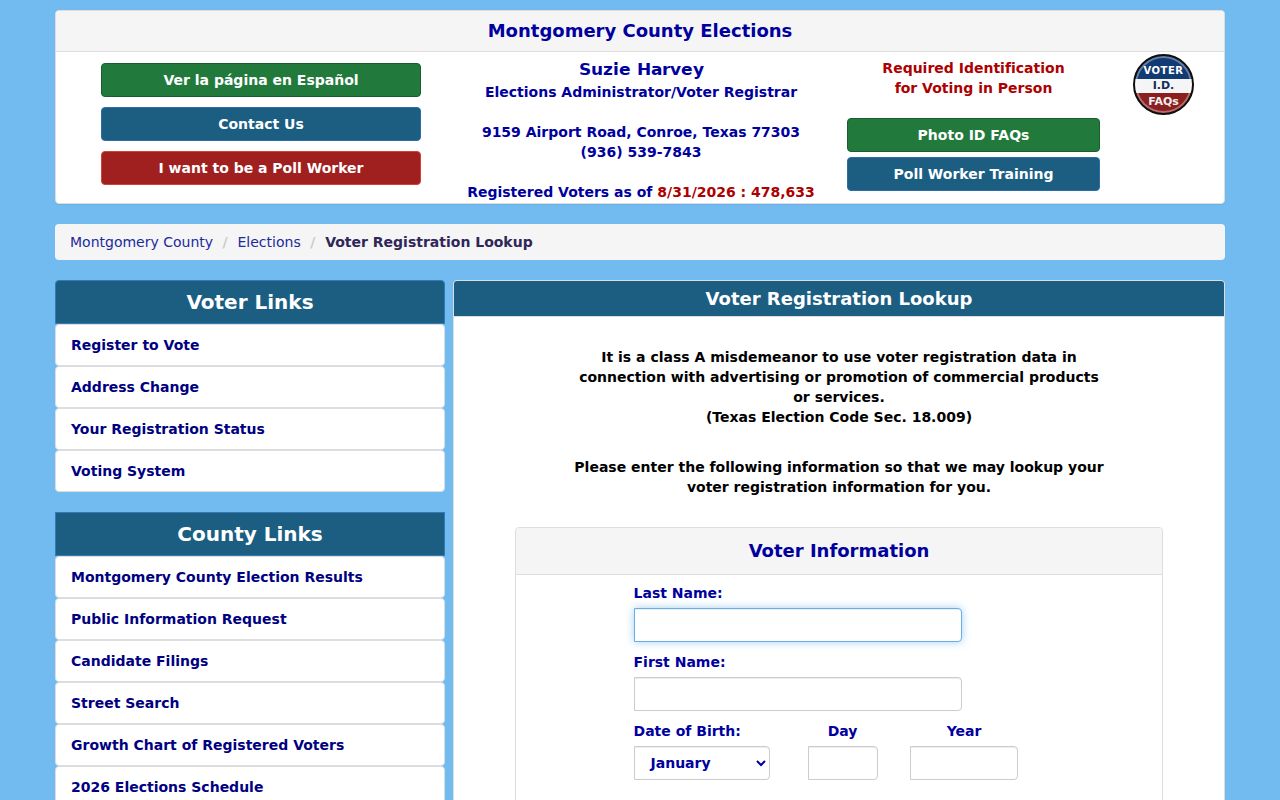
Use the returned record only for the limited registration question, then confirm identity with an independent, dated official source.
Common mistake: A homestead entry or a voter match may support a narrow, record-specific inference. Neither proves that every household member lives at the address.
Conroe Resident Lookup Court Records
Montgomery County Odyssey Court Records Inquiry visibly offers Criminal Records, Civil & Probate Case Records, and Court Calendar categories. Its detailed local result fields did not load during the research inspection, so treat the category screen as an entry point rather than a promise of a complete result. Save the court and case number, then obtain a plain or certified copy from the proper clerk when the document itself matters. A clerk-office public terminal may show more search context than the web interface, while still following sealing and confidentiality rules.
re:SearchTX provides a statewide participating-court gateway after a free account is created. It supports county, court, case, party, and document searching, but participation and historical coverage vary, and a listed document may be paid or restricted. TAMES is for appellate cases and documents, refreshes nightly, and does not maintain trial-court records. For federal matters, PACER requires an account and applies its current per-page or document charges.
The Texas re:SearchTX court research gateway is an official statewide supplement when the Conroe resident lookup needs another participating court.
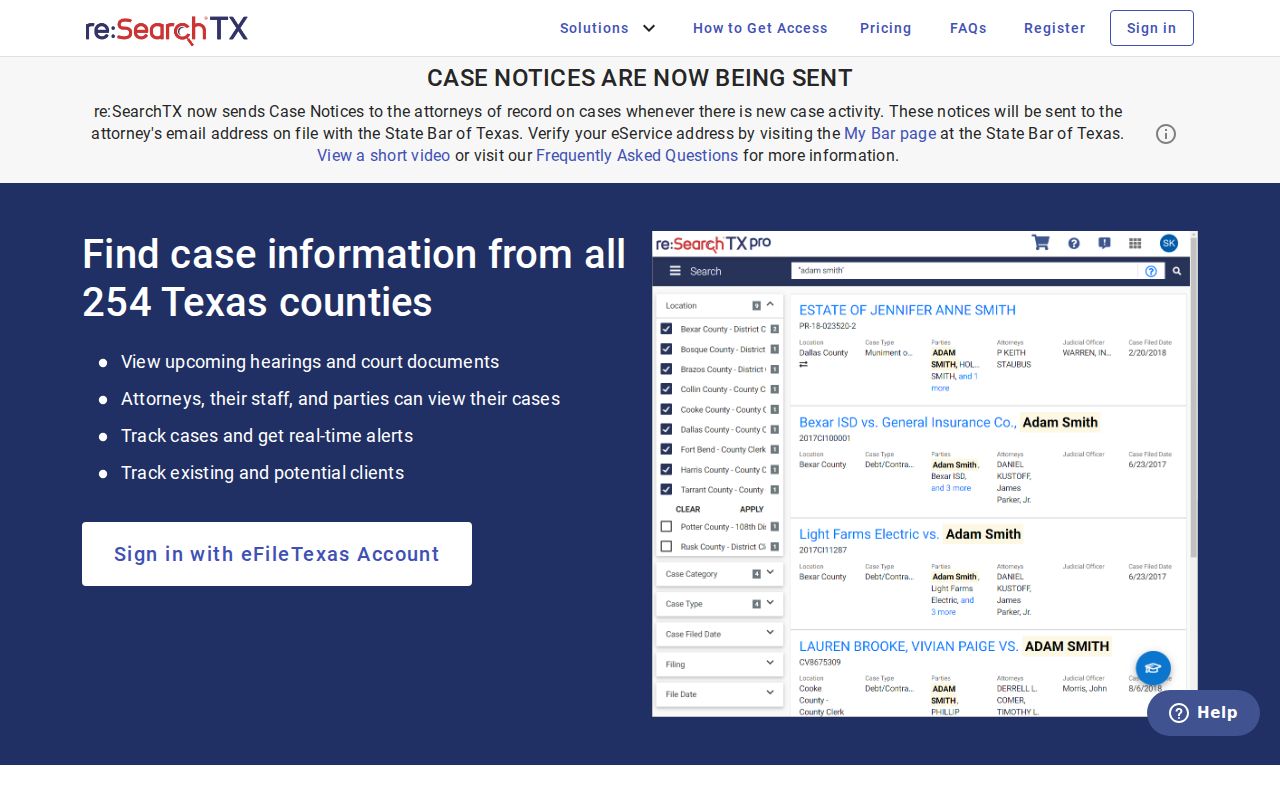
Its account requirement and participating-court limits mean a local clerk remains the authoritative source for the underlying copy.
The County Odyssey inquiry screen shows the three local categories available before a Conroe resident lookup reaches a docket.
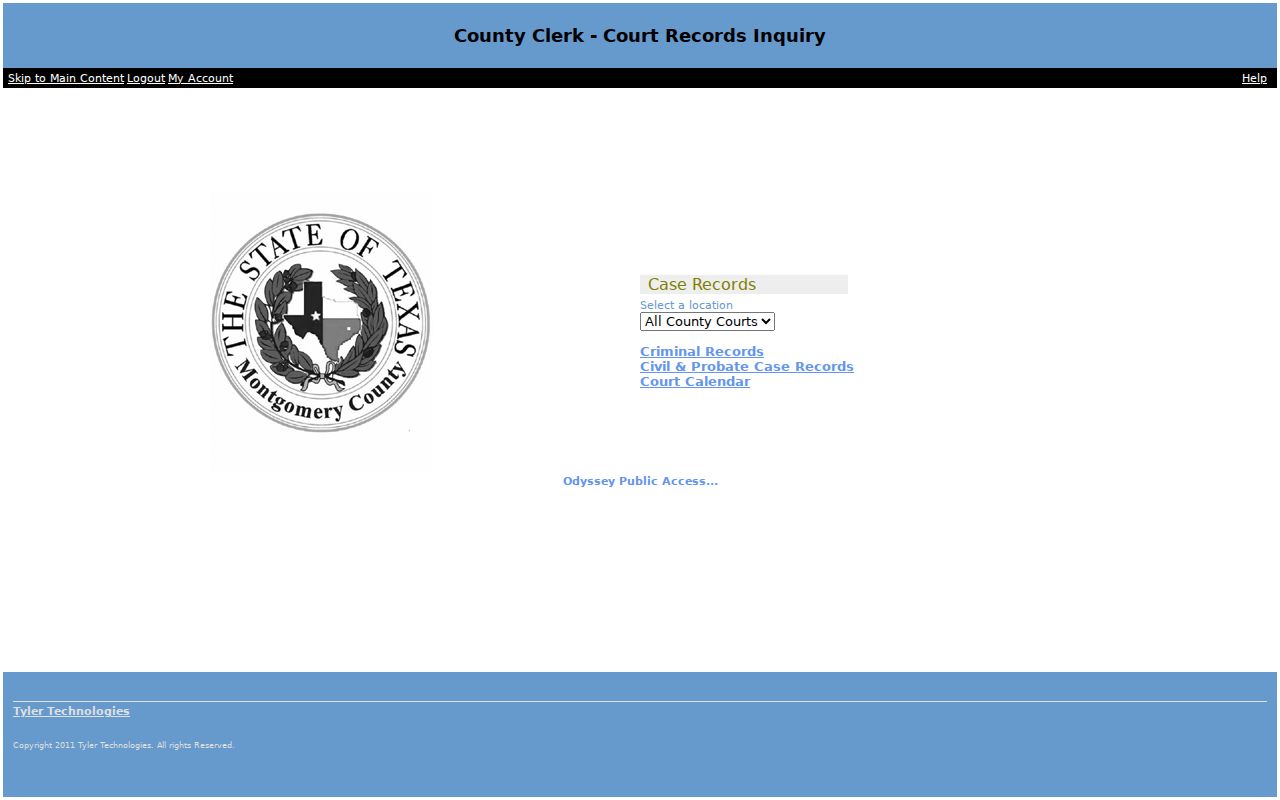
Because no local docket sample loaded in the inspection, this image documents the available categories, not a person’s case record.
| Documented case-result field to inspect | Why it matters |
|---|---|
| Case number and court | Identifies the custodian and the file to request. |
| Style or party names | Helps compare spelling and party role with another identifier. |
| Filing date and case type | Places a name in the correct time and category. |
| Events, hearings, and disposition or judgment | Separates a filing from a later outcome. |
| Document links and redaction or sealed markers | Signals whether access is restricted or a clerk copy is needed. |
These are inspection targets identified in the research, not fields observed in an individual Montgomery County docket. Juvenile, adoption, sealed, expunged, and confidential matters may be absent or partly redacted. A docket records a case, not a character label or a current-residence finding.
Conroe Resident Lookup Vital Custodians
Montgomery County Clerk handles local births, deaths, marriage licenses, and local copies, while Texas DSHS Vital Statistics is the statewide route for birth and death records and marriage or divorce verifications. Birth records become public after 75 years and death records after 25 years under Texas Government Code section 552.115, subject to the unidentified-death rule. Newer protected records require a qualified requester and identification.
Marriage and divorce requests go to different places. A certified marriage license comes from the county clerk. A divorce decree comes from the district clerk. DSHS issues a marriage or divorce verification, which is not a certified license or decree. The state order system requires a Texas event, an adult applicant, identity and payment information; most orders take 20 to 25 business days and are nonrefundable. DSHS supports online, mail, phone, and local-registrar channels, while Montgomery County provides local online-vendor, in-person, and mail form routes. Montgomery County’s birth record page also notes that Kingwood HCA births are outside its local registration district.
The DSHS vital-forms index displays the official form routes that apply to a Conroe resident lookup.
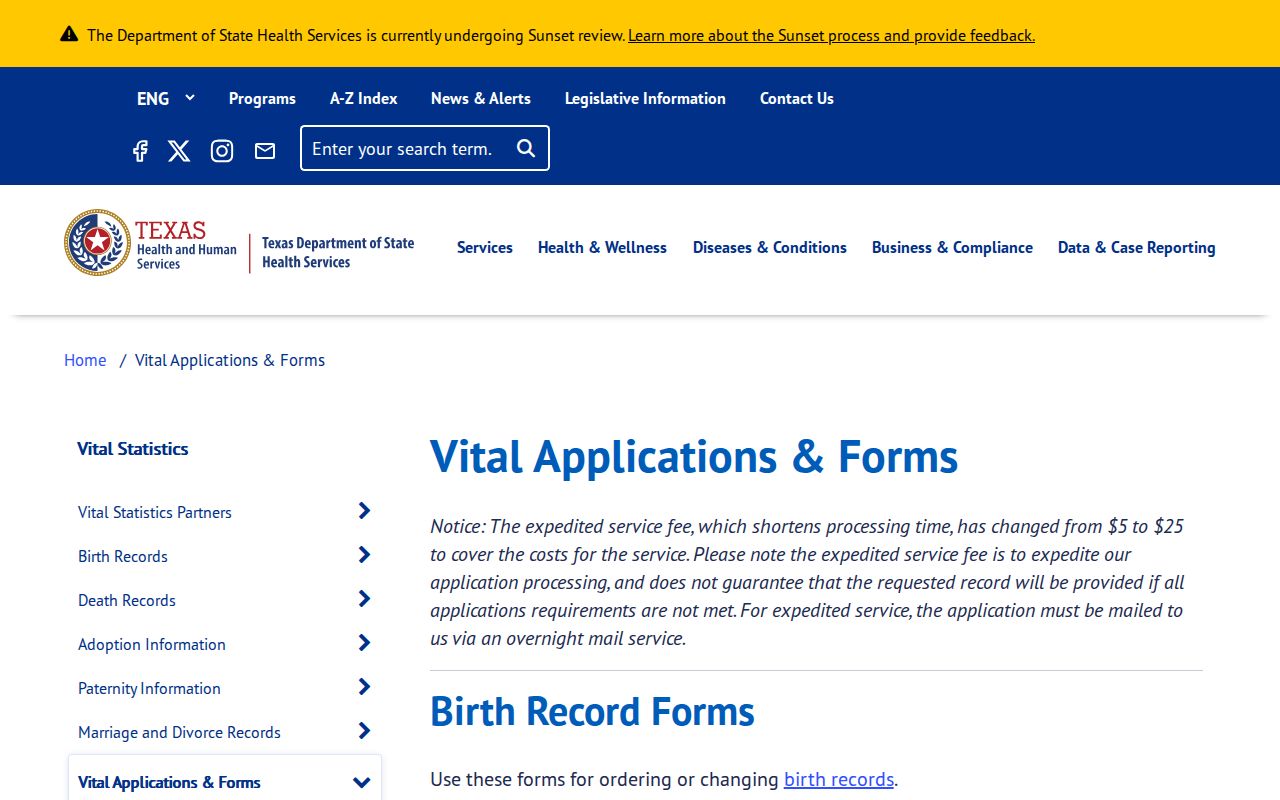
The form catalog includes birth, death, marriage and divorce verification, correction, adoption, and paternity materials, each with its own eligibility rules.
Texas DSHS online ordering is the state route for eligible Texas vital-record requests.
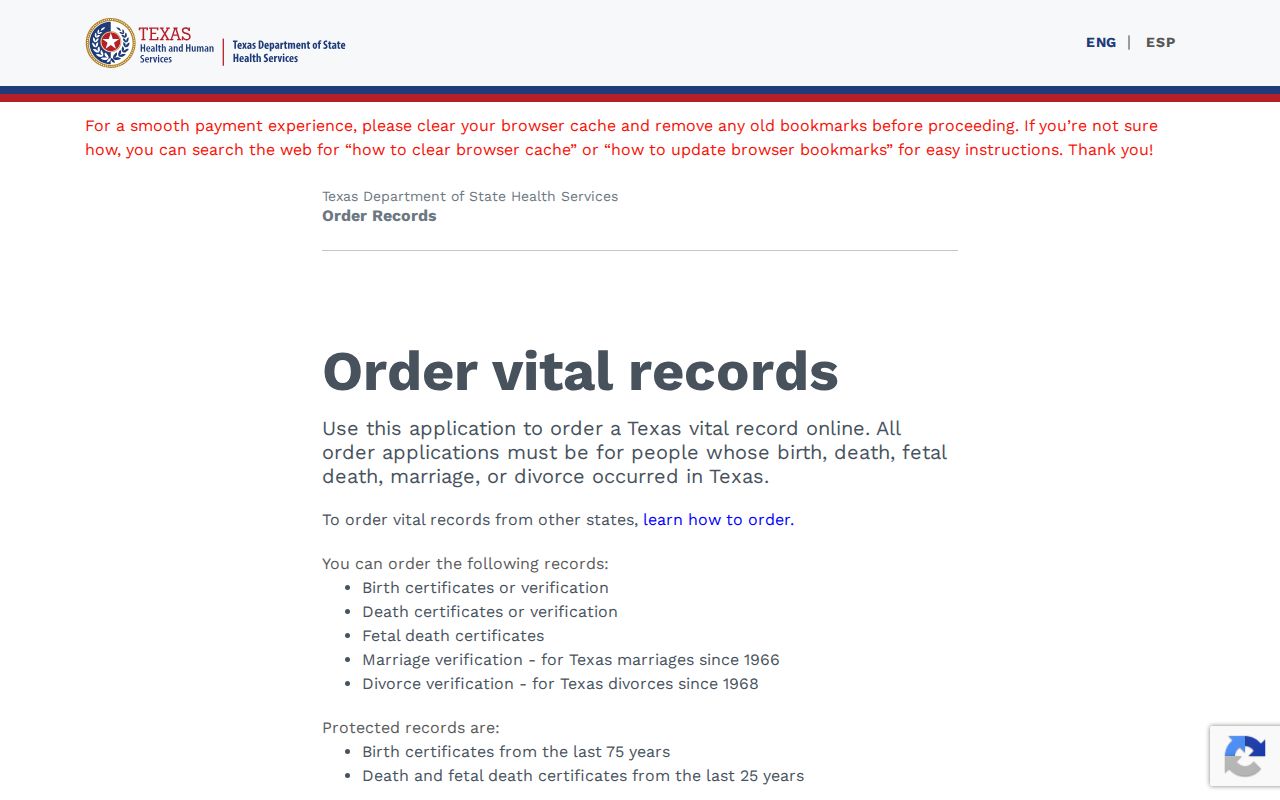
The order path requests record type, event and applicant information; it is not an open name-search database.
- Birth request: applicant and contact details, event details, identity proof, and the appropriate certificate product.
- Death request: record details and qualified-applicant documentation for protected records.
- VS-142.9 verification: applicant details, names, dates or locations, identifying details, photo-ID copy, signature, date, and payment.
- Divorce record: district-court decree request, rather than a DSHS verification, when a certified decree is required.
Verify a Conroe Resident
Use a sequence that makes each new search test the last one. That is safer than collecting every result for a name. A parcel identifier, a dated filing, or a confirmed birth-date field is more useful than a broad list of similar names. Keep a note of where each fact came from, including the custodian and search date, because live county portals can change.
- Start with the exact name plus an address, date, parcel ID, or another second identifier.
- Use MCAD to separate the parcel’s situs from the recorded owner mailing field and retain the PropID, GEO ID, and legal description.
- Check the county voter lookup only for a lawful name-and-DOB registration match, then compare a dated County Clerk instrument or court case.
- Use county or DSHS vital channels only when the requested record and eligibility route fit the question. Request a custodian copy when certification matters.
- Docket
- A court’s running record of a case, including filings, events, hearings, and any listed disposition.
- Index
- A searchable list pointing to records. It may show less than the underlying image or clerk file.
- Image
- A scan of an underlying document. An image can be paid, redacted, restricted, or unavailable even when its index entry is public.
- Certified copy
- A copy authenticated by the custodian for uses that require official certification, rather than an ordinary research copy.
Note: If an exact address is the starting point rather than a name, use the Conroe street directory for the full address-to-parcel workflow.
Conroe Records Requests When Indexes End
A missing online item may still exist at the custodian. For a deed, filing, or older instrument, use the Montgomery County Clerk Public Records Search to capture what is available, then request a copy or ask where an archived record is stored. The clerk’s copy-request form accommodates specific instrument, book, page, document type, and page information and gives a 24 to 72 hour estimate. Do not infer an online index start date when the portal has not published one.
For a county-held record not available in a portal, the Montgomery County public-information request route accepts a written request under the Texas Public Information Act. Ask for an existing record by type, date range, address, instrument number, or case number, and state a preferred delivery method. The Act does not require a government body to create a report, answer broad questions, or perform open-ended research. Its ten-business-day framework applies when an agency seeks an Attorney General ruling or needs to respond about withholding.
Note: A narrow request also makes it easier to identify redactions, copy charges, and the proper office before paying for a record.
Privacy Limits on Conroe Resident Lookup
Texas public access is record-specific. The Texas Address Confidentiality Program can provide a substitute mailing address for qualified survivors, and protected-voter rules can suppress a residence address. A missing address is not proof of a move. Motor-vehicle information is restricted by the federal Driver’s Privacy Protection Act, and sensitive identifiers may be redacted from recorded or court documents. Household composition, utility information, delivery data, and unlisted phone information are not public resident lists.
Use the record for a personal, lawful purpose and minimize what you retain. If a public record contains an error, ask the appraisal district, elections office, court, DSHS, or other custodian for its correction process and provide supporting documentation. For eligible address protection, consult the Texas Attorney General’s Address Confidentiality Program.
Lawful use. A Conroe resident lookup is for careful personal research. Using a public-record detail to stalk, harass, threaten, or intimidate anyone can be unlawful under Texas law.