
Conroe Past Residents by Era
Previous residents of a Conroe address appear in different sources at different times. Use a current parcel record to anchor the address, then choose the source that matches the era. County deed records can lead back through recorded ownership, although the official web portal does not state its exact historical indexing start. The printed directories, maps, newspapers, and census schedules each provide a narrower kind of evidence. An absence in one source is not proof that an address or person was absent from Conroe.
| Source | Years it covers | Where held | What it can show |
|---|---|---|---|
| County Clerk real-property records | County series from 1838; web cutoff not stated | Clerk portal, office, books, and copies | Deeds, liens, plats, recorded party roles, and legal descriptions |
| MCAD, tax, and GIS records | Current or selected appraisal year | MCAD, tax portal, county and city maps | Parcel identifiers, owner and mailing fields, situs, values, and map context |
| Conroe printed directories | 1984, 1988, 1990, 1992 | Texas State Library and Archives Commission | Period address, telephone, and possible household notation |
| UNT local newspapers | Reported nineteenth century through 1940s material | UNT and Montgomery County Memorial Library collection | Notices, obituaries, businesses, fires, and social references |
| Conroe Sanborn map | 1938, nine sheets verified | Library of Congress | Building footprints, uses, streets, and lot context |
| Federal census schedules | Released under the 72-year rule | Census, NARA, and library research routes | Historical household, relationship, age, and location evidence |
City permits and Certificate of Occupancy records are another contemporary layer, but no historical start date was verified for that system. Start at the parcel when the address is known. Start in a dated directory or newspaper when the only starting point is a name from a particular period. Note: The four verified directory years are snapshots, not evidence that every year between them survives.
Conroe Past Residents Start With a Parcel
For a Conroe previous-residents search, copy the current property address, PropID, GEO ID, Tax Office ID, legal description, subdivision, and lot or block before pursuing names. The street address is a useful label, but the legal description is what carries a parcel through older deeds. MCAD’s parcel card can also show current owner and secondary-owner fields, an owner mailing address, location or situs address, exemptions, value history, map ID, market area, and taxing units.
Keep the owner mailing address separate from the situs address. A person or entity can receive tax mail at another location, and a parcel can be held through an estate, trustee, or business. A homestead field is evidence within the property-tax record, not proof of every person who was present. Use the Montgomery Central Appraisal District Public Portal to obtain the current parcel key, then use the county parcel map to confirm geometry and boundaries.
Trace Conroe Past Residents Through Deeds
The deed chain is the strongest backward ownership path for an address. Search the current MCAD owner as a grantee in the County Clerk index, then use the acquisition instrument to find the seller. The seller becomes the next grantee search. Read each document for party roles, recording date, instrument number, legal description, and any volume or page reference. Search the same legal description when a deed does not repeat the modern street address.
- Open the current parcel card and record its legal description, subdivision, lot or block, PropID, and GEO ID.
- Search the current owner as grantee in the Montgomery County Clerk Public Records Search. Narrow by an approximate acquisition date or recorded document type when needed.
- Read the acquisition instrument or request a copy. Preserve the grantor, grantee, legal description, recording date, and instrument or volume and page number.
- Search that grantor as a grantee, using the same legal description. Repeat the sequence for each earlier transfer.
- When a party is an estate, business, or deceased person, search the estate name, personal representative, DBA, corporate name, probate records, and plat references as alternate leads.
- Grantor
- The party who conveys or gives an interest in a recorded instrument.
- Grantee
- The party who receives an interest. Searching a prior seller as a grantee can identify that person’s earlier acquisition.
- Chain of title
- The linked sequence of recorded transfers for the same property interest. It can contain gaps, entities, and records outside the visible web index.
- Legal description
- The land description used in the instrument, often a subdivision with lot and block or metes-and-bounds. It is more durable than a changing street label.
A recorded owner is not necessarily a past occupant. Pair the deed trail with a dated directory, census schedule, obituary, or newspaper reference before identifying who lived at the address. The current street-by-street method is covered separately in the Conroe street directory.
Conroe Past Residents at the Clerk
The County Clerk’s Quick Search uses a Search Term field for a grantor, grantee, subdivision, document type, or document number. Date-range fields and presets can reduce a large result set. The portal also separates Search Index Only from Search Index & Full Text. Multiple words in an index search are treated as separate words, while OCR can search a phrase. Use a street term as a lead, not as a substitute for the legal description.
The County Clerk Public Records Search is the online entry point for the Conroe previous-residents deed trail.
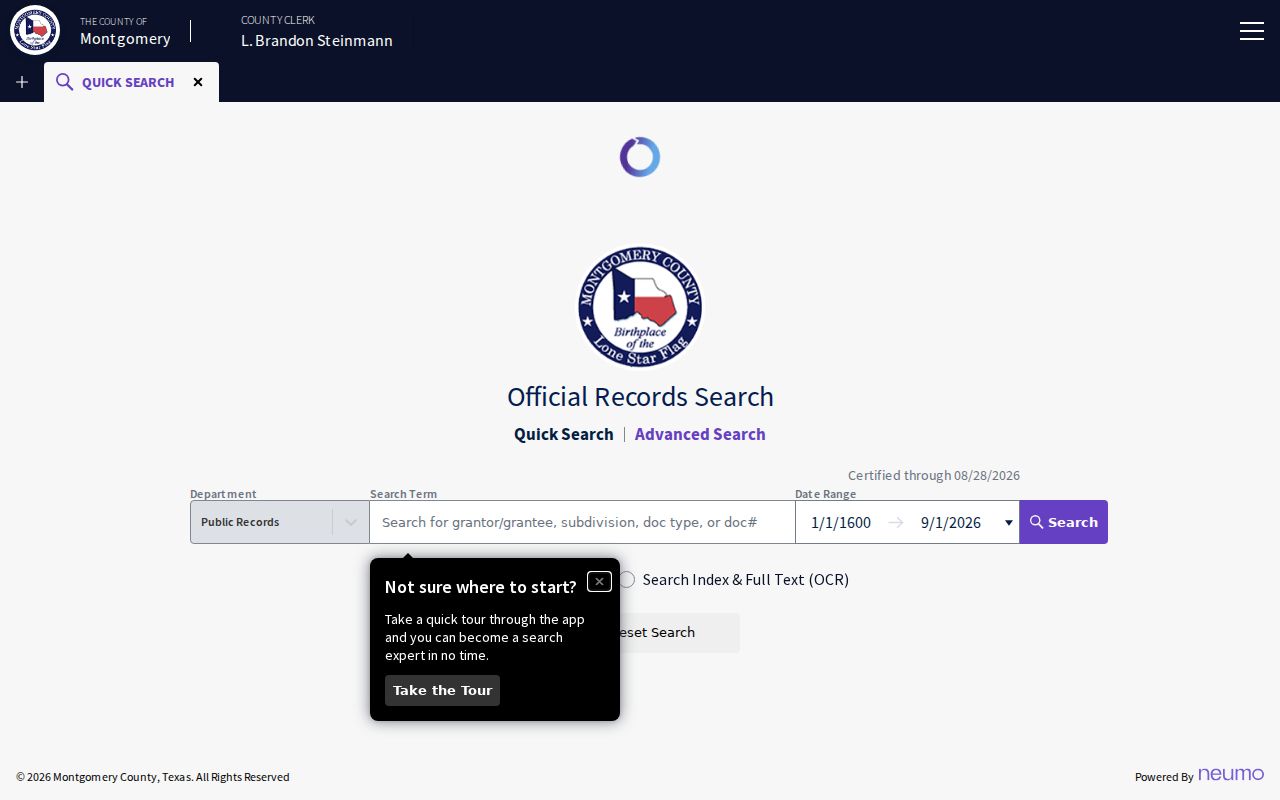
Its county record series reaches to 1838, but the Clerk has not stated the exact online cutover. Older books, microfilm, or office assistance may be needed. Do not treat a portal blank as the first year of county records.
Conroe Address History Copy Requests
The Clerk’s Recording and Real Property office provides the formal copy path when an online image is unclear, unavailable, or incomplete. Plain copies are listed at $1 per page, and certification adds $5 per document. The official public-record copy form asks for the requester’s contact information, instrument number or volume and page, book type, number of pages, and plain or certified selection. It allows up to eight record lines and states an estimated 24 to 72 hour turnaround, subject to workload and volume.
The Montgomery County Clerk recording page explains the office’s real-property record categories and copy access.
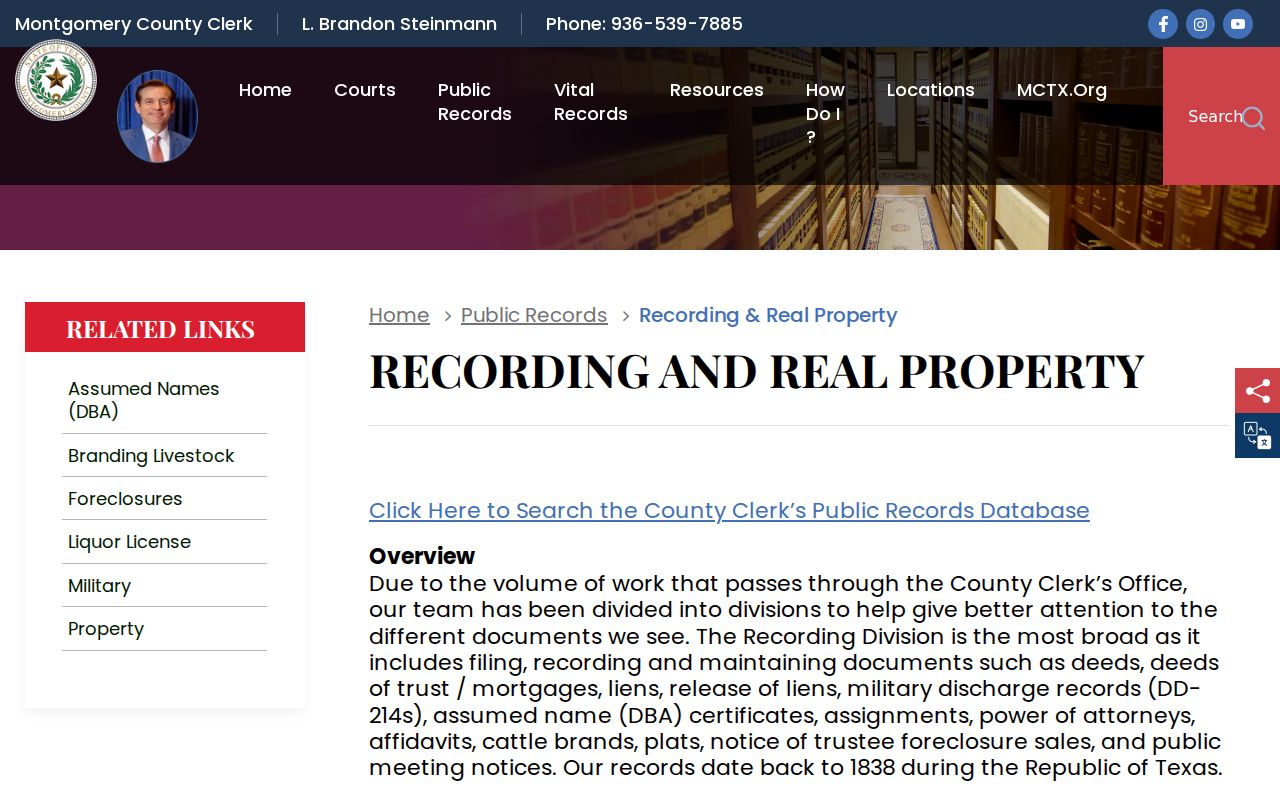
For a mail request, use the official copy-request form and follow its payment, ID-copy, and self-addressed stamped-envelope instructions. A narrow request with an instrument number or book and page is easier for staff to process than a request to research an entire address history.
Conroe Past Residents in Four Directories
TSLAC lists four verified Conroe directory years: 1984, 1988, 1990, and 1992. That limited run is useful precisely because the gaps are visible. A directory can place a name, street address, telephone number, spouse notation, or other period clue beside a year. A reverse or criss-cross arrangement can begin with the address. It can also reflect a business, boarding location, or incomplete household listing, so it should be compared with the source’s abbreviation key and a second record.
- Choose the directory year nearest the time being researched and search the street address or name in the available arrangement.
- Compare the same address in the next verified Conroe volume, rather than assuming a missing intervening year exists.
- Pair an older directory lead with the nearest released federal census schedule, then compare surname, location, relationship, and date.
- Use county deed or tax evidence to distinguish a recorded owner from a directory association at that address.
- Keep a dated timeline that identifies each source and its limitation.
The TSLAC holdings list confirms the four years, while the TSLAC research guide explains directory fields and access limits. The books are generally used in the Austin Reference Reading Room or through partner and library routes. Staff do not perform directory searches by phone or email. Note: Census schedules have a 72-year release rule, so they cannot fill recent directory-era gaps at the person level.
Conroe Address History and Downtown Change
For a downtown Conroe address, use the 1938 Sanborn map as a building and street-context source, not as a list of people. The verified Library of Congress item has nine sheets. It can show a building footprint, use, street layout, and lot setting. Compare it with a current parcel map and then seek names in deed records, directory volumes, or newspaper pages. The map establishes a physical setting; it does not establish an occupant.
The 1938 Conroe Sanborn sheet can be paired with digitized Conroe Courier material at the UNT Montgomery County Memorial Library collection. A 1911 newspaper page reports that a fire burned much of the courthouse-area business district and left three buildings. That event can explain rebuilt fabric or a discontinuous downtown address trail, but it cannot replace a deed or a dated directory entry.
Conroe Address History Permit Context
City permits and Certificate of Occupancy material can date a building change, a submitted project, or a prior and proposed use. CityView’s records layers can expose planning and engineering record points, flat-file numbers, Initial or Final Certification, and building context. A completed Certificate of Occupancy record may include owner, applicant, contractor, architect, signature, and date fields. Those names identify document roles and should not be confused with every person who lived at the address.
Use the City of Conroe records GIS layer for the online record point. If the layer supplies only a reference number, request the existing record under the Texas Public Information Act by naming the address, date range, record type, and preferred delivery. No verified citywide historical permit-index start was located, so describe any result by its displayed date rather than assuming a complete run.
Conroe Past Residents Property Alert
Montgomery County offers a free GovOS Property Alert that emails when a matching name appears in a real-property recording. It is a useful way to notice a new filing connected with a name already found in a Conroe deed trail. The alert is not a title guarantee, fraud prevention service, or proof that a named person occupies a property. Verify the actual instrument through the County Clerk before relying on an alert message.
The Montgomery County Property Alert sign-up is the official free route.
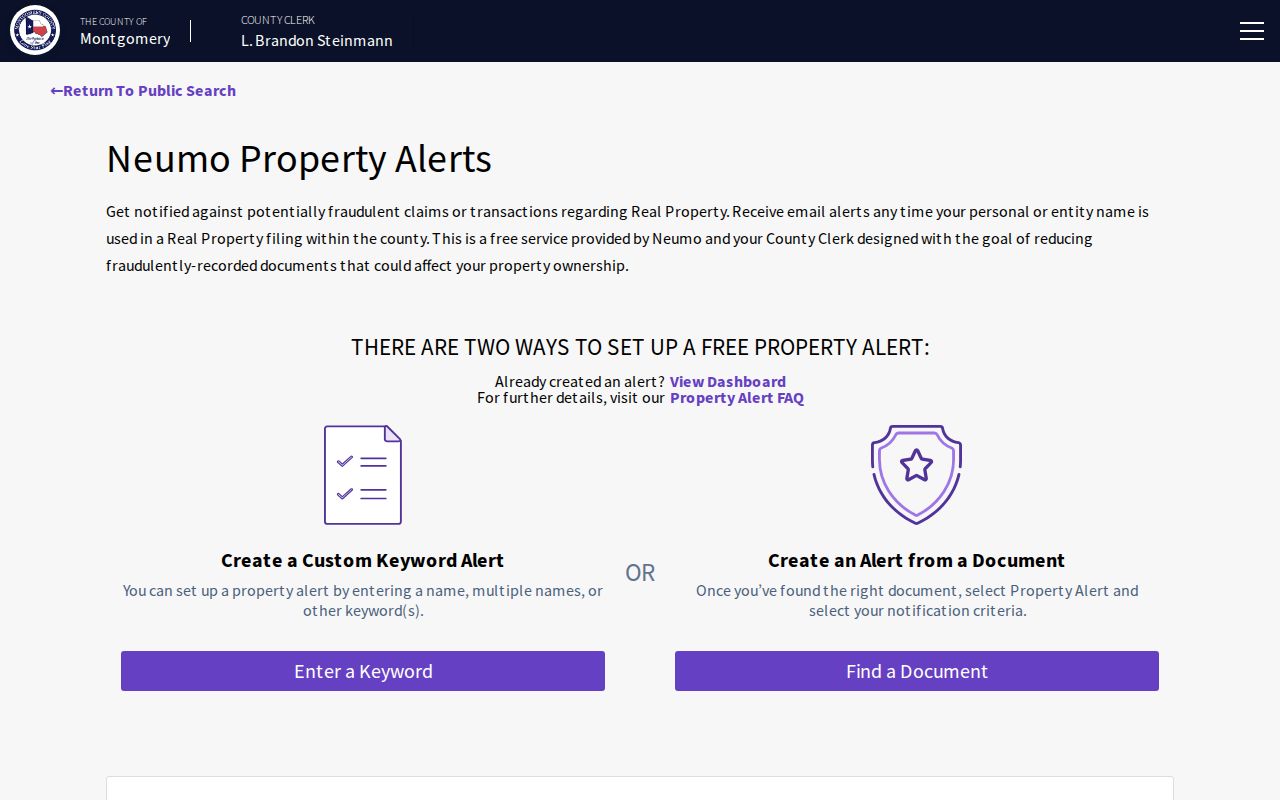
The Clerk cites record-fraud protections and provides this service as a notification tool. It is especially useful when a historic name remains relevant to a later recorded instrument, but the notice must always be matched to the recording date, legal description, and party role.
Conroe Address History Privacy Limits
Previous-residents research should remain a house-history, family-history, estate, or civic-record exercise. A property record may identify a recorded owner without identifying an occupant. A historic directory can omit household members. An obituary or probate file can provide an estate lead while withholding sensitive details. Texas protections can suppress voter addresses, and motor-vehicle residence information is restricted. Never treat a missing record as permission to infer a private address or family relationship.
Lawful use. Use Conroe previous-residents records for legitimate personal and historical research. Do not use a past address, deed, obituary, or map result to threaten, repeatedly contact, stalk, or harass any person.
The Texas Public Information Act provides a route to existing government information subject to exemptions. It does not require an office to create a new resident history, answer an open-ended question, or disclose protected material. A precise copy request, a library consultation, and a clear record date are the appropriate fallback when the online trail ends.